
ISV Marketing, Visibility & Partner Ecosystem Growth
The ISV Society Blog helps Independent Software Vendors (ISVs) build clarity, visibility, community, and collaboration within ERP and technology ecosystems.
Explore practical insights on ISV marketing, partner marketing, ecosystem engagement, thought leadership, community building, joint initiatives, and growth strategies designed to help software companies become known, trusted, and recommended.
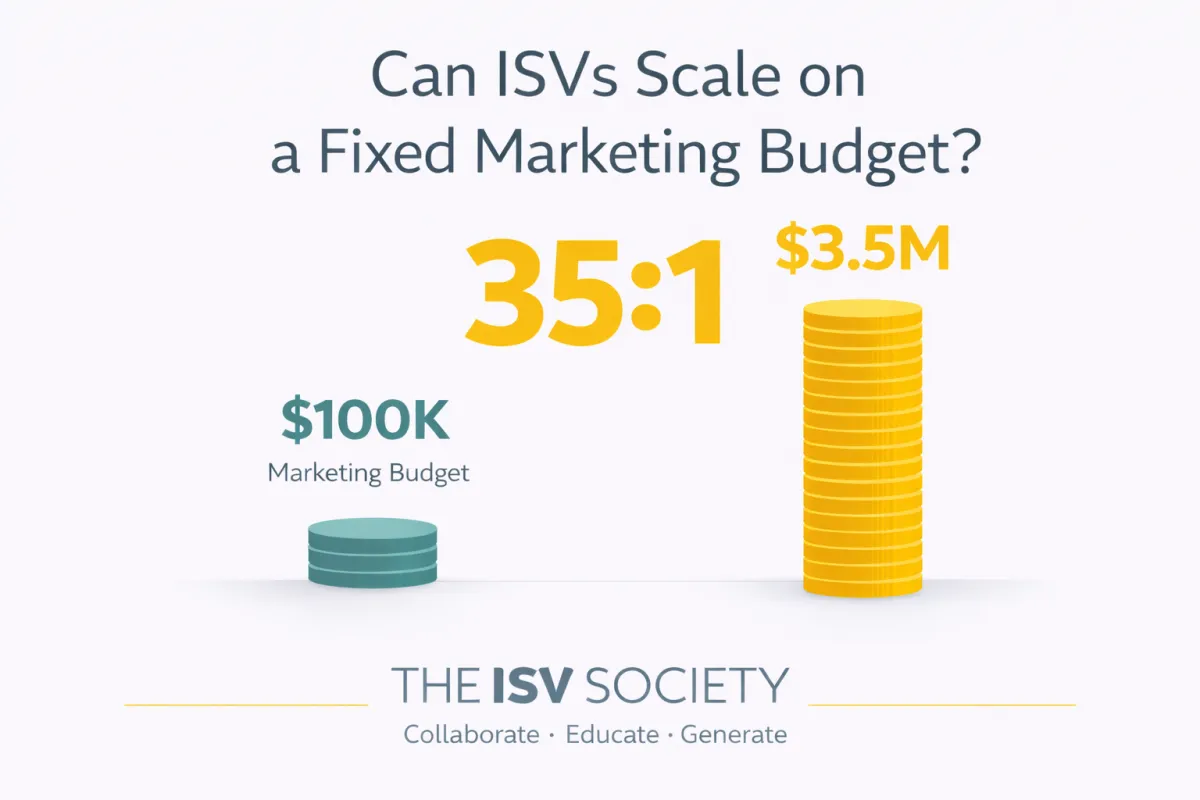
Can ISVs Scale on a Fixed Marketing Budget?
Introduction
In the ERP and ISV ecosystem, ambitious revenue targets are nothing new.
What is increasingly common and quietly stressful is being handed a multimillion-dollar booking goal with a marketing budget that doesn’t seem to match.
Imagine this:
A $3.5 million booking target.
A $100,000 marketing budget.
A small team.
No additional headcount.
No additional spend.
That’s a 35:1 revenue-to-marketing ratio — in a long-cycle ERP environment where trust takes time and relationships drive decisions.
When you look at a $3.5M booking goal paired with a $100K marketing budget, the instinct is to assume the answer is “more spend.” But in the ERP ecosystem, visibility isn’t always a budget problem — it’s a leverage problem. Scaling doesn’t require being everywhere; it requires showing up consistently in the right places. I’ve explored this idea more deeply in Visibility Without a Six-Figure Marketing Budget, because the real unlock for many ISVs isn’t bigger campaigns. It’s smarter, ecosystem-based exposure that compounds over time.
Let’s unpack why this happens and more importantly, how ISVs can navigate it strategically.
Understanding the Discrepancy Between Revenue Goals and Marketing Budgets
The misalignment between revenue targets and marketing budgets is rarely malicious. It’s structural.
Revenue goals are typically set at the executive level. They’re based on growth forecasts, investor expectations, market expansion plans, or competitive positioning.
Marketing budgets, on the other hand, are often:
Based on prior year spend
Determined conservatively
Allocated after sales hiring
Viewed as support rather than a revenue multiplier
As a result, goals scale faster than budget.
In ERP ecosystems specifically, this gap becomes more pronounced because sales cycles are longer and trust must be earned through repetition. Yet revenue targets often assume faster traction than the ecosystem naturally allows.
The issue isn’t effort — it’s alignment.
The Reality of ERP Sales Cycles: Trust Drives Bookings
In ERP and ISV environments, deals rarely close because of a single campaign or one event appearance.
They close because:
Partners recognize your brand
Buyers have seen you multiple times
Familiarity reduces perceived risk
Sales teams have credible proof points
Trust, familiarity, and ecosystem presence drive conversion.
If marketing is measured only by:
Lead volume
Event attendance
MQL counts
It can miss the underlying factors that drive bookings.
Marketing in ERP ecosystems must be structured to build:
Repeated exposure
Partner credibility
Sales-supporting momentum
Cold awareness alone won’t carry a $3.5M booking goal.
Strategies for Achieving Ambitious Goals with Limited Resources
When budget is constrained, strategy must tighten.
1. Stop Spreading Budget Thin
With a $100,000 marketing budget, you cannot afford to:
Sponsor every event
Enter multiple new ERPs simultaneously
Test every new channel
Run disconnected campaigns
Breadth feels productive.
Depth drives results.
Choose:
One or two key ecosystems
One or two repeatable initiatives
A consistent marketing rhythm
Repeatable visibility compounds. One-off moments rarely do.
2. Shift from Awareness to Leverage
When budget is limited, cold awareness campaigns become expensive and inefficient.
Instead, focus on:
Partner-based exposure
Shared visibility initiatives
Borrowed trust through collaboration
Ecosystem-driven programs
Collaboration stretches marketing dollars further than solo efforts.
Leveraging established partner trust reduces friction in the sales cycle and accelerates credibility.
3. Build Momentum, Not Moments
A single $25,000 sponsorship will not carry a $3.5M booking goal.
But consistent, affordable, repeatable initiatives can.
Momentum builds when marketing is:
Turnkey
Easy to execute
Affordable to repeat
Built into a predictable cadence
Visibility should not feel like a one-time push.
It should feel like a rhythm.
Momentum increases familiarity.
Familiarity increases trust.
Trust increases conversion.
Investing in Sales-Enhancing Content
Marketing’s role does not stop at lead generation.
If bookings are the goal, marketing must support:
ROI-focused webinars
Contextual short demos
Customer proof stories
Partner enablement materials
Sales acceleration content
Sometimes the highest-impact marketing initiative is not bringing in more leads — it’s helping sales close more effectively.
When budget is fixed, increasing conversion rate often yields greater impact than increasing top-of-funnel volume.
Making the Most of Fixed Budgets
If the $3.5M target and $100K budget are not changing, clarity becomes critical.
1. Speak in Math
Marketing leaders should articulate:
Average deal size
Required deal count
Historical conversion rates
Pipeline requirements
This shifts the conversation from emotional frustration to strategic alignment.
2. Practice Ruthless Prioritization
Some initiatives must stop.
Not deprioritized.
Stopped.
Dividing a limited budget across too many efforts guarantees none of them create meaningful impact.
Focus drives momentum.
3. Redefine Leading Indicators
If bookings are aggressive, track indicators that reflect momentum:
Partner engagement
Repeat exposure
Win-rate improvement
Sales cycle acceleration
Ecosystem familiarity
Lead volume alone does not tell the full story in ERP marketing.
Conclusion: Turning Constraint into Strategy
The numbers don’t break because teams aren’t working. They break because visibility, trust, and conversion aren’t aligned.
I’ve seen this cycle repeat for over 20 years in partner marketing. The ISVs that navigate it successfully aren’t the ones with the biggest budgets. They’re the ones who build momentum through collaboration, repeatable visibility, and smart ecosystem leverage.
If you’re staring at aggressive numbers this year, don’t panic.
Start with structure.
Prioritize what compounds.
Cut what doesn’t.
And if you need help thinking through what that looks like in your ecosystem, I’m always open to a conversation.
Because making marketing affordable and effective for ISVs isn’t just a strategy — it’s the mission.

© Copyright 2022 The ISV Society