ISV Marketing, Visibility & Partner Ecosystem Growth
The ISV Society Blog helps Independent Software Vendors (ISVs) build clarity, visibility, community, and collaboration within ERP and technology ecosystems.
Explore practical insights on ISV marketing, partner marketing, ecosystem engagement, thought leadership, community building, joint initiatives, and growth strategies designed to help software companies become known, trusted, and recommended.
Which ERP Marketing Initiative Fits Your Goals?
TL;DR
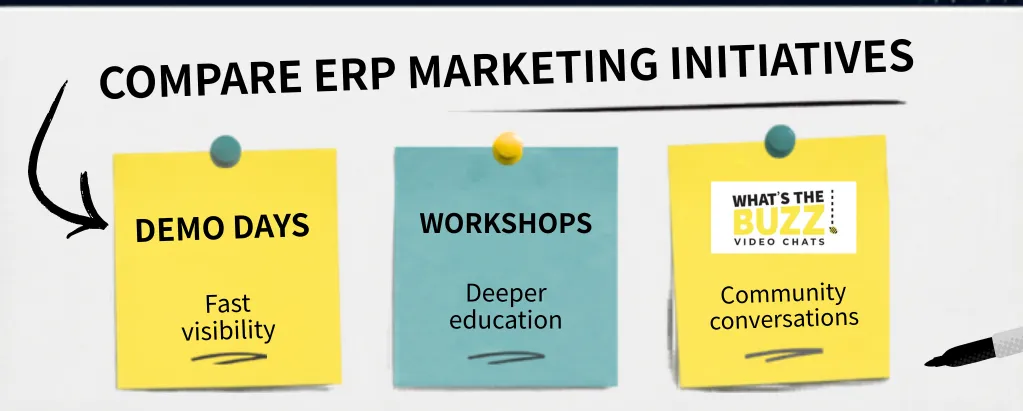
Not every ERP marketing initiative is designed to accomplish the same thing. Some help ISVs gain fast visibility. Others are better for thought leadership, education, or community engagement.
This guide compares Demo Days, Workshops, and the What’s the Buzz Monthly Chat to help ERP ISVs choose the right initiative based on their goals, audience, and growth strategy.
ERP Demo Days vs Workshops vs Sponsorships: Which Marketing Initiative Fits Your Goals?
There’s no shortage of ways for ERP ISVs to market their solutions today.
Webinars. Demo Days. Sponsorships. Workshops. Podcasts. Events. LinkedIn. Newsletters.
The challenge isn’t usually finding marketing opportunities.
It’s figuring out which initiatives actually align with the outcome you’re trying to achieve.
Because not every ERP marketing initiative is designed to do the same thing.
Some help you build visibility quickly.
Some help establish long-term authority.
Others create stronger partner relationships, educational positioning, or industry credibility.
One of the biggest mistakes ERP ISVs make is treating every initiative as if it should accomplish every goal.
That’s rarely how ecosystem marketing works.
The ERP space is relationship-driven. Recognition matters. Repeated exposure matters. Educational positioning matters. Community participation matters.
The most successful ISVs are usually the ones consistently showing up in multiple ways across the ecosystem.
This comparison guide breaks down common ERP marketing initiatives and where each one fits best.
Not Every Initiative Should Be Measured the Same Way
One of the reasons ISVs become frustrated with marketing is because they evaluate every initiative using the exact same expectations.
A workshop shouldn’t be judged the same way as a quick visibility campaign.
A sponsorship shouldn’t be measured the same way as a live demo event.
And a thought leadership initiative may not generate immediate leads, but it can significantly increase ecosystem recognition over time.
ERP ecosystem marketing is rarely about one-touch attribution.
It’s usually about:
repeated visibility
familiarity
educational credibility
ecosystem participation
partner alignment
staying top of mind
That’s why the strongest ERP marketing strategies often involve a mix of initiatives working together.
Demo Days
Best For:
Fast visibility
Product awareness
Solution discovery
Lead generation
Ecosystem exposure
Demo Days work especially well because they remove friction for attendees.
Instead of sitting through long vendor presentations over and over, attendees get exposed to multiple solutions in a single afternoon through short, focused demos.
For ISVs, this creates:
shared audience momentum
collaborative promotion
faster visibility
stronger registration numbers
more ecosystem exposure
Demo Days are especially effective for:
newer ISVs
launching new functionality
increasing ecosystem awareness
introducing solutions to partner audiences
Industry Demo Days
Best For:
Vertical positioning
Industry workflows
Day-in-the-life storytelling
Showing how solutions fit together
Industry Demo Days create a different type of conversation.
Instead of focusing only on features, the discussion becomes:
how work actually gets done
industry bottlenecks
disconnected workflows
operational visibility
finance and operations alignment
This format helps ISVs position themselves within a larger workflow story rather than as a standalone tool.
That matters in ERP ecosystems, where customers and partners often work to solve operational challenges across multiple systems and departments.
Workshops
Best For:
Deep education
Strategic conversations
Complex solution positioning
Thought leadership
Some ERP solutions require more context.
A 15-minute demo may create awareness, but workshops create understanding.
Workshops are ideal when:
the topic is complex
the audience needs education
strategy matters more than features
process change is involved
there are multiple stakeholders involved
These initiatives often create stronger engagement because attendees stay longer and participate more actively in the conversation.
What’s the Buzz Monthly Chat
Best For:
Community engagement
Industry conversations
Educational visibility
Building familiarity within the ecosystem
Not every initiative needs to feel like a formal webinar or sales presentation.
Sometimes the most valuable conversations happen through shorter, more casual discussions around trends, challenges, workflows, and what’s happening across the ERP ecosystem.
What’s the Buzz Monthly Chat helps create:
consistent visibility
educational conversations
relationship-building opportunities
ecosystem familiarity
ongoing engagement with partners and customers
These types of conversations help ISVs stay visible in a way that feels approachable and community-focused rather than overly promotional.
What ERP Audiences Actually Respond To
ERP audiences have heard a lot of the same messaging over the years.
And ERP marketing starts sounding the same after a while.
Phrases like:
“streamline operations”
“increase efficiency”
“AI-powered innovation”
“seamless integration”
These words can start to feel interchangeable across the ERP space.
What ERP teams actually care about is:
where the workflow breaks down
where manual work slows teams down
where data gets disconnected
where communication gaps happen between departments
where processes create bottlenecks
where reporting lacks visibility
where teams are forced into spreadsheets and workarounds
That’s where ERP ISVs create real value.
Not by talking in broad buzzwords — but by clearly communicating the gaps they help solve inside real operational workflows.
ERP audiences respond more to:
real workflow conversations
operational pain points
practical education
industry-specific examples
community insights
relatable business challenges
clear explanations of process gaps and inefficiencies
The ISVs that stand out are usually the ones helping customers and partners better understand:
what’s missing
what’s slowing teams down
where inefficiencies exist
how solutions fit into larger business processes
Because often the challenge isn’t that companies need another piece of software.
It’s understanding where things are still breaking down, slowing people down, or creating extra work — and how ISVs help solve those gaps.
A lot of ERP teams are still dealing with:
manual steps
disconnected processes
too many spreadsheets
duplicate work
chasing information
workarounds that have become “normal”
That’s where ISVs make a real impact.
Not by throwing around buzzwords, but by helping teams make everyday work easier, faster, and less frustrating.
Frequently Asked Questions
What is the best ERP marketing strategy for ISVs?
There usually isn’t one single initiative that accomplishes everything. The strongest ERP marketing strategies combine visibility, education, thought leadership, and community participation over time.
Are webinars still effective for ERP audiences?
Yes — especially when they are educational, collaborative, short, and focused on solving real business challenges instead of generic product pitches.
What’s the difference between Demo Days and workshops?
Demo Days focus on fast visibility and solution discovery through shorter presentations. Workshops focus more on deeper education, strategic discussions, and process conversations.
How do ERP ISVs build visibility?
The ISVs gaining the most momentum are usually the ones consistently participating in:
educational content
ecosystem conversations
partner collaborations
community discussions
events
repeated visibility initiatives
Final Thoughts
ERP ecosystem marketing works differently than traditional SaaS marketing.
Visibility alone usually isn’t enough.
The ISVs that stand out are often the companies consistently building:
clarity
visibility
community
collaboration
over time.
At The ISV Society, we call this The CVCC Growth Framework:
Clarity → helping the market understand who you are, what you solve, and where you fit
Visibility → consistently showing up across the ecosystem
Community → participating in conversations, education, and relationship-building
Collaboration → working alongside partners, complementary ISVs, and ecosystem leaders
In ERP ecosystems, recognition is rarely built through a single campaign.
It’s built through repeated participation, educational conversations, community engagement, and showing up consistently where the ecosystem is already paying attention.

© Copyright 2022 The ISV Society